Building a Pool on Sand: What Goes Into an Outer Banks Pool Shell
The pool you see is mostly finish work. The part that decides whether it lasts is underneath it.
October 17, 2026 · 4 min read
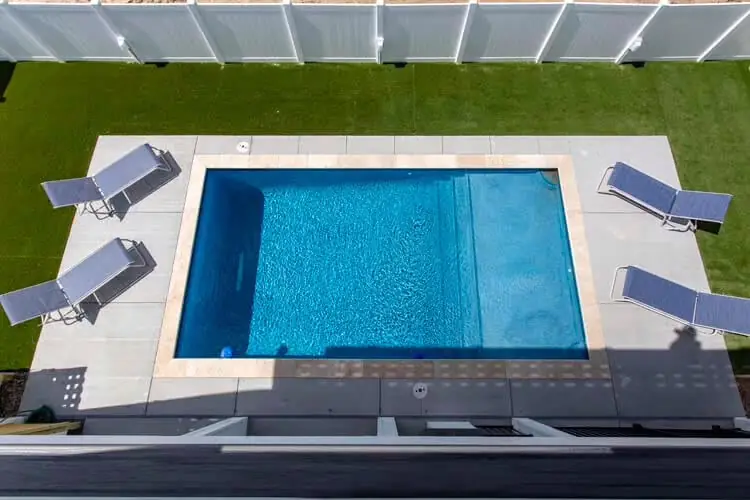
Anybody who has dug a hole on the beach knows how sand behaves. It looks solid until you put weight on it, and then it moves. An Outer Banks pool is a very heavy structure sitting in exactly that kind of ground, anywhere from Corolla to Cape Hatteras. Colin Cox, who runs the construction side of Four Seasons Pool Builders, builds around that fact. Here's what goes into a shell, in roughly the order it happens.
It starts before the dig
Our published construction process begins with pre-planning, permitting, and a pre-site visit by the project manager, followed by plan approval and layout. Plans are reviewed against the 2012 ISPSC, the International Swimming Pool and Spa Code, and there's a pre-construction meeting so the owner knows what happens next. Every client also gets a 3-D rendering before construction, which is a much cheaper place to change your mind than a finished deck.
Over-dig and compact
In sandy soil we over-dig the excavation by 6 to 12 inches and compact it. The reasoning is simple. Loose sand under a pool floor can settle unevenly, and uneven settling is one of the ways a shell ends up cracked. Digging below the final depth and rebuilding that layer compacted gives the shell a firm, even base instead of a loose one. It's the least glamorous step in the whole job, and one of the more important.
Steel and shotcrete
Next comes the steel. We use #4 rebar, which is half an inch thick, tied into the cage that defines the shape of the pool. Then the shell is shot with shotcrete at a minimum of 8 inches in the walls and the floor. We describe that as 33% stronger than the industry standard, which is our own published comparison.
Shotcrete is concrete sprayed at high velocity against the steel, and it packs densely around the rebar. Thick walls and floor matter in sandy ground because the shell has to handle the weight of the water pushing out, and the ground pushing in when the pool is drained for service.
The locking beam
At the top of the wall sits a 12 inch locking beam with a four bar bond beam. It ties the perimeter of the shell together like a belt, and it's the edge the tile, the coping and the deck all land against. A shell without a strong top edge can flex there, and the tile line is where you'd see it first.
Bonding the deck
Water and electricity share the same backyard, so a wire mesh in the deck is bonded to the pool equipment. The idea is to keep all the metal around the pool at the same electrical potential, so stray ground current has a safe path and doesn't find a swimmer. It's one of those details you never see once the pavers or concrete are down, which is why it's worth knowing it was done.
Plumbing and spas
For spas, we run suction plumbing at a minimum of 1.5 inches with separate returns. That's about letting the pump move water without straining, and keeping the flow to each fitting under control. It's another detail owners never look at but a pump feels every day. A spillover spa, raised spa, waterfall or deck jet is only as good as the plumbing behind it.
After the shell
From there the list gets more familiar: pre-grade, tile and coping, plumbing, electric, deck, screen, interior finish, final clean, and pool school, where the owner learns how their pool runs. Decks can be travertine, artistic or pavers, and pavers are our answer for owners who want to avoid the cracking and chipping common in traditional poured concrete. Finishes range from white to midnight blue, chosen for each property.
What the warranty says
A warranty is easier to trust when it matches how the pool is built. Ours, as published, looks like this:
- Shotcrete shell: lifetime
- Plaster finishes: 5 or 10 years
- Pool light, cleaner, pump, filter, heater and controls: 3 years each
- Tile, coping, decking and skimmers: 2 years each
Jeff and Colin Cox started out building pools from Corolla to Hatteras in 2004, working for a company out of Virginia Beach during the years when hundreds of houses a year were going up across the Outer Banks. In 2007 they started Four Seasons Pool Builders Inc, based in Point Harbor. Today Colin and his crew run construction. If you're thinking about a new pool in Duck, Kitty Hawk, Southern Shores or anywhere else along the Banks, call (252) 207-6986 and we'll talk through what the ground and the plans call for.
Four Seasons Pools & Spas, (252) 207-6986
Call (252) 207-6986More articles
What Happens at Every Weekly Pool Visit on an Outer Banks Rental
Weekly service sounds simple until you ask what is actually done on each stop. Here is the full visit, and how rental weeks change it.
Opening an Outer Banks Pool in Spring: Why It Takes Four Days
Pulling the cover is the easy part. Getting a winter pool swim-ready is a process, and the calendar matters.