Saltwater Conversion and Keeping Pool Equipment Alive by the Ocean
Salt in the pool, salt in the air: what it means for chlorinators, heaters and fiberglass surfaces on the Outer Banks.
October 17, 2026 · 3 min read
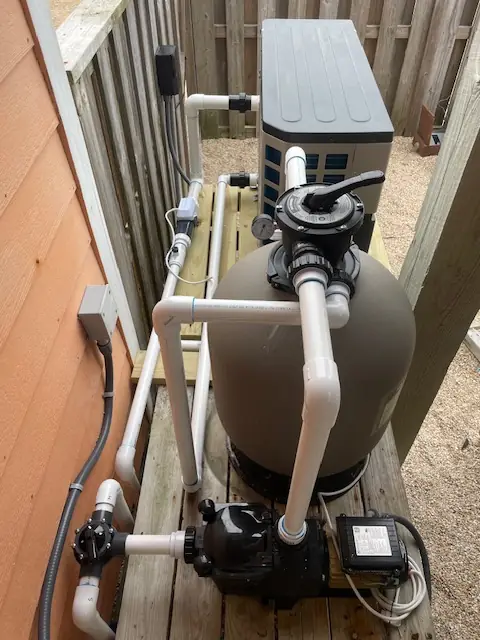
On the Outer Banks, salt shows up whether you invite it or not. It's in the air, on the deck furniture, on the car after a drive along the beach road. It makes sense that pool owners from Corolla to Nags Head ask us about saltwater pools, and that the ones who already have a pool want to know what the coast is doing to their equipment. Here's a plain look at saltwater conversion, the gear that lives on your equipment pad, and the surface care that gets forgotten.
What a saltwater conversion actually is
A saltwater pool isn't chlorine-free. It's a pool with a salt chlorinator, a unit that makes chlorine from dissolved salt as the water passes through it. Instead of adding chlorine by hand, you add salt to a low level and let the chlorinator do the producing. Many owners like it because the water tends to feel softer and the routine is steadier.
Our saltwater conversion is priced under $1,000, one time. That covers turning a conventional pool into a salt-chlorinated one. We list it among our standard services alongside salt chlorinators, so if you already have a unit that needs attention, that's something we work on as well.
What conversion doesn't change
Salt doesn't mean you stop testing. The water still needs free chlorine, pH, total alkalinity, calcium hardness and cyanuric acid checked and balanced, and the chlorinator cell still needs to be looked at. Salt water is also harder on certain materials than fresh water, including some metals, so a pool that has been converted needs a closer eye on fittings, ladders and equipment. Weekly service, with a full water analysis and equipment inspection on every visit, handles all of this as routine.
Salt air and the equipment pad
Even a conventional pool on the Outer Banks lives in a salty environment. Pumps, filters, valves, heaters and controls sit outside, in damp, salty air, year round. Rust on a fastener, a motor that's gotten loud, a heater cabinet with flaking paint: these are the early notes of a bigger story. The most useful habit an owner can have is to look at the pad now and then and mention what changed. Our techs inspect the equipment on every weekly visit, and they carry common parts, so small things can often be fixed on the spot.
Why a certified service center matters
We're a Sta-Rite and Hayward Certified Service Center. In practical terms, that means we work on these brands as a matter of routine, not as a favor. Pump trouble, filter trouble and control problems are repairs we do, and when the repair doesn't make sense, we also handle replacement. It's worth asking any service company which brands they're actually certified on, because a brand name on a truck and a certification are different things.
Heaters and heat pumps
A heater is the piece of equipment that most often decides whether a pool gets used in the shoulder seasons, and it's one of the pieces that suffers most from salt air. We repair and replace pool heaters, including the Hayward H-Series, and we work with HeatPro heat pumps for owners who want energy-efficient heating. If your heater is slow to start, short-cycling or showing a fault, the sooner it's looked at, the more options you have.
The surface nobody thinks about: fiberglass gelcoat
Fiberglass pools have a gelcoat surface, and a white, chalky film can show up on it when calcium silicate scale forms. It's usually tied to water balance drifting, particularly calcium hardness, pH and temperature. It's far easier to prevent than to remove, and prevention is mostly a matter of testing regularly and correcting small drifts before they add up. We care for fiberglass gelcoat as part of our service work, including preventing calcium silicate whitening.
A short checklist for coastal pool owners
- Look at the equipment pad monthly and write down anything that changes, from rust to noise
- Keep the water balanced, since scale and corrosion both start with a number that drifted
- Ask about conversion if you're tired of handling chlorine, and remember it still needs regular testing
- Get heater problems looked at early, before a slow start becomes a dead unit
- Have the spa checked along with the pool, since it's the same salty air and the same equipment story
If you'd like a second opinion on your equipment, or you're curious what a saltwater conversion would look like for your pool in Kill Devil Hills, Southern Shores or Point Harbor, call (252) 207-6986.
Four Seasons Pools & Spas, (252) 207-6986
Call (252) 207-6986More articles
What Happens at Every Weekly Pool Visit on an Outer Banks Rental
Weekly service sounds simple until you ask what is actually done on each stop. Here is the full visit, and how rental weeks change it.
Opening an Outer Banks Pool in Spring: Why It Takes Four Days
Pulling the cover is the easy part. Getting a winter pool swim-ready is a process, and the calendar matters.